
Story highlights
- Why do Indian passports come in four colors and who gets them?
- Passports are not just travel documents; they are the primary form of identification for international travel.
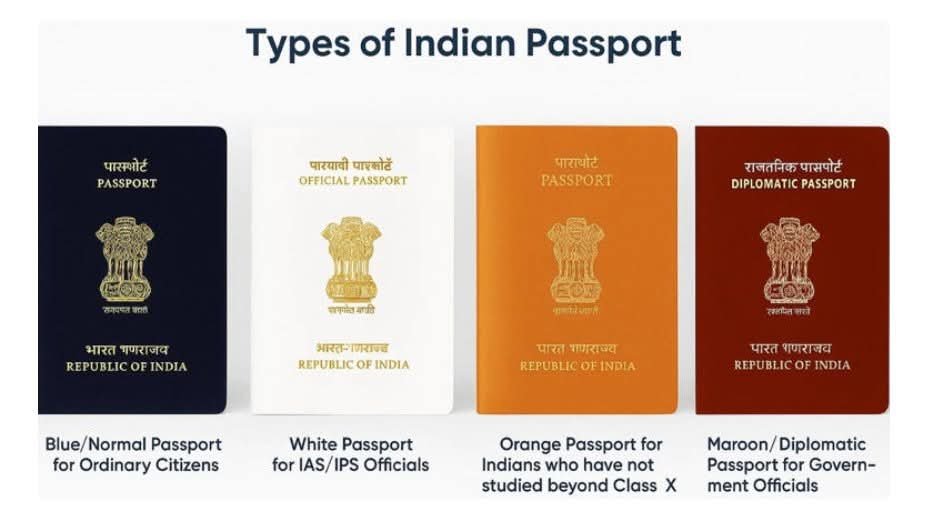
- Like many countries, India issues its own passports, using four different colors (blue, white, red and orange) to indicate the status of travelers or their purpose of travel.
Why do Indian passports come in four colors and who gets them? Passports are not just travel documents; they are the primary form of identification for international travel. Like many countries, India issues its own passports, using four different colors (blue, white, red and orange) to indicate the status of travelers or their purpose of travel. Each color serves a specific purpose, helping immigration officials identify them at a glance. India’s passport system, which is managed by the Ministry of External Affairs under the Passport Act of 1967, has seen significant evolution. The recent introduction of e-passports containing biometric chips has made foreign travel faster, safer and more convenient for Indian citizens. Blue: Regular Passport The blue passport, officially known as the Ordinary Passport, is the most widely used type of passport in India. It is intended for personal, educational, business or leisure trips abroad. Millions of Indians hold this passport, which is now available as an e-passport with an embedded biometric chip for smoother migration and enhanced security. To apply for a blue passport, citizens need to provide proof of birth such as a birth certificate, a valid photo ID such as Aadhaar or PAN card, proof of residence (e.g. electricity bill or rent agreement), and proof of nationality. These requirements ensure a secure and efficient issuance process. White: The white passport for government officials is only applicable to government officials, civil servants, and military personnel traveling on official business. Its color indicates their official status and may confer certain special privileges at immigration desks. Like the blue passport, it is now issued as a secure e-passport with an RFID chip to prevent tampering. Obtaining this passport is a very rigorous process. Applicants need to provide a government-issued ID, a duty certificate from their department, an official forwarding letter, and a clearance from the Prime Minister’s Office (PMO). These steps are in place to ensure that official travel is safe and properly monitored. Red: Diplomatic Privileges The red or maroon passport is reserved for diplomats, senior government officials and their families. Holders of this passport enjoy diplomatic privileges such as expedited visa processing and often have visa-free access to many countries. Red passports are also issued in e-passport format, which increases their security and international acceptance. The application for a diplomatic passport involves rigorous verification, including official ID, duty certificates, forwarding letters and PMO clearance. This ensures that only authorized individuals have access to sensitive diplomatic travel. Orange: ECR Passport The orange passport is issued to Indian citizens with Emigration Check Required (ECR) status. This category usually includes individuals who have not completed a certain level of education or are traveling to specific countries for work that requires additional clearance. Orange indicates that the passport holder must undergo additional immigration procedures before traveling abroad. Why passport colors matter Whether traveling for leisure, business, official duty, or work, the color of the passport immediately conveys important information. Blue indicates personal travel, white indicates official duties
indicates, red indicates diplomatic status and orange identifies ECR travellers. This system, combined with modern biometric e-passports, will make international travel easier, safer and more efficient for all. By combining clear classification with modern technology, India’s passport system is now in line with global standards, providing confidence and convenience to citizens, officials and diplomats while crossing international borders.